

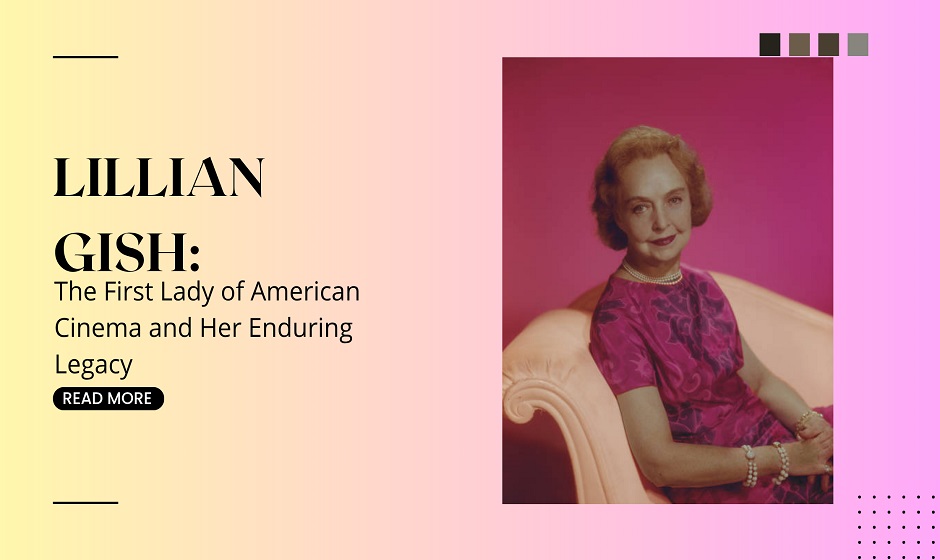

When we discuss the architects of modern film acting, one name stands as a towering, luminous beacon: Lillian Gish. In an era when cinema was still considered a novelty without a language, Gish helped invent the grammar of emotional expression on screen. Her career is not merely a list of film credits; it is a living history of Hollywood itself, spanning an unprecedented 75 years from the silent shorts of 1912 to the poignant dramas of the late 1980s. Known as the “First Lady of American Cinema,” Lillian Gish’s influence on the craft of acting is immeasurable.
In this biography, we will explore the life of this extraordinary artist, from her tumultuous childhood in Ohio to her reign as the muse of director D.W. Griffith, her triumphant return to the stage, and her legacy as a fierce guardian of film history .
Quick Facts About Lillian Gish
| Category | Details |
|---|---|
| Full Name | Lillian Diana Gish |
| Age | 99 years (at the time of death in 1993) |
| Date of Birth | October 14, 1893 |
| Date of Death | February 27, 1993 |
| Height | 5 ft 5½ in (1.66 m) |
| Weight | Approx. 53 kg (117 lbs) |
| Nationality | American |
| Profession | Actress, Director, Writer |
| Estimated Net Worth | $10 Million (at time of death, adjusted for inflation) |
Early Life and Family Background
Lillian Diana Gish was born on October 14, 1893, in Springfield, Ohio . She was the eldest daughter of Mary Robinson McConnell, a woman of deep faith and resilience, and James Leigh Gish, a wandering merchant. Lillian Gish’s childhood was far from the glamour of the silver screen; it was marked by instability and poverty. Her father was an alcoholic who struggled to maintain steady work, eventually deserting the family entirely.
With her father absent, Lillian Gish and her younger sister Dorothy Gish were raised primarily by their mother. To support the family, Mary Gish took work wherever she could find it, eventually opening a candy store adjacent to the Majestic Theater in East St. Louis, Illinois . It was here that the sisters were first exposed to the intoxicating world of performance. Recognizing that her daughters’ wages could help keep the family afloat, Mary joined a traveling stock company, and soon young Lillian and Dorothy were performing in plays.
Lillian Gish’s education was unconventional. As the family moved between Massillon, Ohio, and New York, the girls were often taught by their mother in dressing rooms and boarding houses. Despite the hardships, Mary ensured her daughters were cultured, reading them history books and exposing them to the arts. This fierce maternal bond forged a protective shield around the Gish sisters that would last a lifetime .
The Beginning of a Legendary Career
The turning point for the Gish family came when they moved to New York. Living next door to a young girl named Gladys Smith—who would later become the legendary star Mary Pickford—changed the trajectory of their lives. In 1912, Pickford introduced Lillian and Dorothy to director D. W. Griffith at the Biograph Studios.
Griffith was immediately struck by Lillian’s ethereal, fragile beauty. However, he initially had trouble telling the sisters apart, reportedly tying ribbons of different colors to their arms to direct them . Lillian made her film debut that same year in the short An Unseen Enemy (1912) . While stage actors of the era looked down upon “the flickers,” Lillian Gish saw the artistic potential in film. She believed in the power of the close-up—that the human face, magnified, could convey subtle emotions the theater could not.
Breakthrough and Silent Film Stardom
Lillian Gish became the definitive muse of D. W. Griffith. Together, they pushed the boundaries of the medium. In 1915, she starred in The Birth of a Nation. While the film remains highly controversial for its racist portrayal of Reconstruction, it was a seismic event in cinema history, cementing the feature-length film as a viable commercial art form. Gish played Elsie Stoneman, a role that made her a household name .
But it was her dedication to realism that would define her legacy. During the filming of Way Down East (1920), there is a famous scene where her character floats unconscious on an ice floe towards a waterfall. Griffith used real winter locations, and Lillian Gish insisted on performing the stunt herself. She lay on a slab of real ice for hours with her hand trailing in the frigid water. The result was cinematic gold, but she suffered permanent nerve damage in her hand and wrist for the rest of her life .
Other triumphs followed, showcasing her incredible range:
- Broken Blossoms (1919): She played Lucy, a young girl beaten to death by her father in a heartbreaking performance of vulnerability.
- Orphans of the Storm (1921): She starred alongside her sister Dorothy in a sweeping drama of the French Revolution.
- The Wind (1928): One of the last great silent films, Gish played a woman driven mad by the relentless prairie winds. It is often cited as her personal favorite performance .
At her peak with MGM, Lillian Gish was offered a million-dollar contract, but she famously turned it down, opting instead for a smaller salary with a percentage of the profits so the studio would have more money to invest in the production quality of her films .
Transition to Sound, Theatre, and Later Career
The arrival of “talkies” in the late 1920s was a difficult transition for many silent stars. Lillian Gish, however, was a trained stage actress. Her voice was clear and resonant, but the public’s taste had shifted. Feeling typecast as an “antique,” she made a graceful exit from Hollywood and returned to her first love: the stage .
For much of the 1930s and early 1940s, Lillian Gish thrived on Broadway. She played Ophelia in a landmark production of Hamlet opposite John Gielgud, proving her classical mettle. She did not abandon film entirely, returning in the 1940s with a powerful performance in the Western Duel in the Sun (1946). Her role as the dying matriarch earned her an Academy Award nomination for Best Supporting Actress .
In 1955, she delivered one of the most beloved performances of her later career in Charles Laughton’s only directorial effort, The Night of the Hunter. She played Rachel Cooper, a fierce, God-fearing protector of children facing off against Robert Mitchum’s terrifying preacher. The role introduced Lillian Gish to a new generation of film lovers who marveled at her strength and moral gravity.
She remained active into her nineties. In 1971, she received an Academy Honorary Award for her “superlative artistry and distinguished contributions to the progress of motion pictures.” In 1987, at the age of 93, she made her final film, The Whales of August, starring alongside Bette Davis .
Personal Life and Lifestyle
Unlike many of her contemporaries, Lillian Gish never married and had no children. She often stated that her career and her sister Dorothy were her life partners. The bond between the Gish sisters was legendary; they lived together for much of their lives until Dorothy’s death in 1968 .
In her later years, Lillian was a fervent advocate for film preservation. She believed silent films were a high art form that were being lost to neglect. She traveled extensively, lecturing at universities and working with the Museum of Modern Art to restore and archive early cinema.
Despite her fragile on-screen persona, Gish was ruggedly independent. She was taught to shoot by a former outlaw and, in her eighties, was still an expert marksman who impressed John Huston and Burt Lancaster with her speed and accuracy with a pistol . She was also known for her sharp wit; even in her nineties, she was reportedly correcting lighting technicians on film sets who had no idea she had been working in the business since before they were born.
Physical Appearance and Fitness
Lillian Gish possessed a distinct ethereal quality that the camera adored. Standing at 5 feet 5½ inches tall and maintaining a slim, light frame, she had a doll-like appearance that contrasted sharply with her inner strength. She had piercing blue eyes and light brown hair, which became iconic when long and flowing in her silent films .
She credited her longevity and youthful energy to a simple lifestyle. Unlike many stars, she never smoked or drank heavily. She remained physically active, walking frequently around her New York City apartment, and maintained a curious, engaged mind, which she considered the key to staying young.
Net Worth and Income Sources
At the time of her death in 1993, Lillian Gish’s net worth was estimated to be $10 million . This wealth was accumulated over a massive 75-year period through various channels:
- Silent Film Salaries: During the 1920s, she was one of the highest-paid women in America. Her decision to take profit percentages rather than flat fees on hits like Way Down East paid substantial dividends.
- Stage Work: Her Broadway runs provided a steady, respectable income during the 1930s.
- Television and Later Films: She was highly paid for guest spots on shows like The Alfred Hitchcock Hour and for films like The Whales of August.
- Royalties and Estates: Her estate continues to generate revenue from licensing deals, screenings, and the sale of her personal memorabilia. She also invested wisely in real estate, owning a notable apartment in Manhattan and property in Connecticut .
5 Interesting Facts About Lillian Gish
- The Expert Gunslinger: As mentioned, she was taught to shoot by a real Wild West outlaw. When preparing for The Unforgiven (1960), she outshot the film’s male leads during practice .
- The Lost Real Estate Deal: She and Dorothy were once offered the chance to buy the Sunset Strip in Los Angeles for $300. They turned it down to buy two dresses at Bullock’s department store .
- The Gold Rings: Whenever she heard that a fan had named their newborn daughter “Lillian” after her, she would send the family a gold christening ring as a gift .
- Garbo’s Teacher: When Greta Garbo arrived at MGM, the studio didn’t know what to do with her. They sent her to the set of The Scarlet Letter (1926) every day just to watch Lillian Gish work. Garbo learned by watching Gish .
- Respect for Griffith: Although Griffith died in relative obscurity and poverty, Lillian Gish remained fiercely loyal. Until her own death, she never called him “D.W.” or “Dave”; she always referred to him respectfully as “Mr. Griffith” .
Frequently Asked Questions (FAQ) About Lillian Gish
Q: How old was Lillian Gish when she died?
A: She was 99 years old. She passed away on February 27, 1993, just eight months shy of her 100th birthday .
Q: What was Lillian Gish’s net worth?
A: Her net worth was estimated to be around $10 million at the time of her death, accounting for her extensive career earnings and real estate investments .
Q: Why is Lillian Gish famous?
A: She is famous for being the “First Lady of American Cinema.” She pioneered film acting techniques during the silent era, starring in D.W. Griffith’s most famous works like The Birth of a Nation and Broken Blossoms, and maintained a career that lasted 75 years .
Q: Did Lillian Gish have any children?
A: No. Lillian Gish never married and had no children. She was exceptionally close to her sister, actress Dorothy Gish, throughout her life .
Q: What is Lillian Gish’s most famous movie?
A: While she made many classics, The Birth of a Nation (1915) is historically the most famous, though controversial. The Night of the Hunter (1955) is arguably her most beloved film by modern audiences .
Conclusion
Lillian Gish was more than an actress; she was a historian, a pioneer, and a living bridge between the birth of motion pictures and the modern blockbuster era. Her impact on the industry cannot be overstated. By collaborating with D.W. Griffith, she helped shift acting from the broad gestures of vaudeville to the nuanced, internal realism we expect today.
She leaves behind a legacy of professionalism, artistic integrity, and physical courage. Lillian Gish proved that a woman could be both a “sweetheart” and a steel-spined professional. For film fans, her body of work offers a masterclass in the art of storytelling, reminding us that long before CGI and digital sound, the power of a single tear rolling down a cheek could break an audience’s heart.