


Quick Facts
Table
| Attribute | Details |
|---|---|
| Full Name | Joseph Frank Keaton IV |
| Date of Birth | October 4, 1895 |
| Date of Death | February 1, 1966 (aged 70) |
| Place of Birth | Piqua, Kansas, United States |
| Nationality | American |
| Profession | Actor, Comedian, Filmmaker, Director, Writer |
| Height | Approximately 5’5″ (165 cm) |
| Weight | Approximately 130–140 lbs (59–64 kg) during his prime |
| Estimated Net Worth at Death | Approximately $500,000 (equivalent to roughly $5 million today); posthumous estate value has grown significantly through film preservation and licensing |
Introduction: Why Buster Keaton Is Famous
Buster Keaton stands as one of the most influential figures in the history of cinema. Known as “The Great Stone Face,” Keaton revolutionized visual comedy through his deadpan expression, death-defying stunts, and innovative filmmaking techniques. Unlike his contemporaries who relied heavily on pathos or overt emotion, Keaton built his comedy on physical precision, elaborate mechanical gags, and an unshakeable stoicism that made even the most absurd situations feel grounded.
His work during the silent film era—particularly between 1920 and 1929—produced some of the most enduring masterpieces in film history. Seven of his films have been preserved in the National Film Registry, a testament to their cultural significance. Time magazine included Sherlock Jr. among its top 100 films of all time, while the American Film Institute ranked him as the 21st greatest male star of classic Hollywood cinema. Critic Roger Ebert famously declared that during his extraordinary period from 1920 to 1929, Keaton became “the greatest actor-director in the history of the movies.”
What sets Keaton apart is not merely his comedic timing but his complete mastery of the cinematic medium. He performed his own stunts at tremendous personal risk, designed intricate mechanical gags that still astonish modern audiences, and developed a visual language that influenced generations of filmmakers from Jacques Tati to Jackie Chan.
Early Life and Family Background
Joseph Frank Keaton IV was born on October 4, 1895, in Piqua, Kansas, to vaudeville performers Joe and Myra Keaton. His entry into show business was practically inevitable—by the age of three, he was already part of the family act, known as “The Three Keatons.” The act specialized in knockabout acrobatics and roughhouse comedy, with young Buster serving as the centerpiece of the physical humor.
The origin of his famous nickname is attributed to magician Harry Houdini, a close family friend. According to legend, after infant Buster took a dramatic tumble down a staircase, Houdini remarked, “That’s some ‘buster’ your baby took.” In vaudeville slang, a “buster” referred to a stage fall, and the name stuck for life.
Growing up in the vaudeville circuit was both grueling and formative. Joe Keaton’s comedy style was genuinely dangerous—he would use young Buster as a “human mop,” throwing him around the stage with little regard for safety. Child protection activists occasionally intervened, but Buster’s remarkable ability to absorb punishment without injury became legendary. He learned to execute pratfalls with perfect technique, ensuring he never broke character or, more importantly, any bones. This early training in controlled chaos would become the foundation of his film career.
Education and Training
Buster Keaton’s education was unconventional, to say the least. Rather than attending traditional schools, his classroom was the vaudeville stage. He learned to read audiences, time his reactions, and execute complex physical routines under the relentless pressure of live performance. By the time he was a teenager, he had already spent over a decade as a professional entertainer.
His technical education in filmmaking came later, through apprenticeship. When Keaton transitioned to film in 1917, he began working with Roscoe “Fatty” Arbuckle, one of the era’s biggest comedy stars. Arbuckle gave Keaton complete access to the filmmaking process, allowing him to learn camera operation, editing, and directorial techniques from the ground up. This hands-on education proved invaluable when Keaton began directing his own films just a few years later.
Career Journey: From Vaudeville to Immortality
The Silent Shorts Era (1917–1923)
Keaton’s film career began when he was drafted into World War I. He served in France with the 40th Infantry Division but never saw combat. He did, however, suffer permanent hearing impairment due to an ear infection—a disability that would affect him for the rest of his life.
Upon returning to the United States, Keaton met Roscoe Arbuckle and appeared in his first film, The Butcher Boy (1917). The collaboration proved immediately successful, and over the next three years, Keaton starred in over a dozen short films produced by Arbuckle, including Out West, The Bell Boy, Moonshine, and the landmark One Week (1920).
In 1920, Keaton starred in his first feature, The Saphead, and established his own production unit under producer Joseph M. Schenck: Buster Keaton Comedies. This independence allowed him to develop his distinctive style—elaborate mechanical gags, long takes in deep focus, and a deadpan protagonist who never smiled no matter how absurd the circumstances.
Between 1920 and 1923, he directed and starred in over 15 short films, refining his approach with each production. Films like The Haunted House (1921), The Boat (1921), and Cops (1922) showcased his growing mastery of visual storytelling and physical comedy.
The Golden Age of Features (1923–1928)
Keaton’s transition to feature-length filmmaking marked the most extraordinary period of his career. He directed and starred in a string of masterpieces that remain unmatched in silent comedy:
- Three Ages (1923) and Our Hospitality (1923): His first directorial features, establishing his ability to sustain comedy across longer narratives.
- The Navigator (1924): His biggest commercial hit, featuring an elaborate underwater sequence that cemented his reputation alongside Chaplin and Harold Lloyd.
- Sherlock Jr. (1924): A groundbreaking film featuring an extended dream sequence with cutting-edge special effects. Modern critics have compared its high-concept execution to Christopher Nolan’s Inception (2010).
- Seven Chances (1925) and Go West (1925): Both out-grossed his previous films and expanded his commercial appeal.
- The General (1926): Keaton’s personal favorite and now widely considered his greatest achievement. Set during the American Civil War, the film featured an epic locomotive chase and a spectacular bridge collapse involving a real train—costing an unprecedented $42,000 to stage. Though a commercial disappointment at the time, it has since been recognized as one of the greatest films ever made, ranking #18 on the AFI’s “100 Years…100 Laughs” list and #34 on Sight & Sound’s 2012 list of the greatest films of all time.
- College (1927): Perhaps his least successful silent feature.
- Steamboat Bill, Jr. (1928): Contains his most famous stunt—standing perfectly still as a two-ton house facade collapses around him, passing through a small open window. The stunt required inch-perfect precision and remains one of the most iconic images in cinema history.
The MGM Years and Decline (1928–1933)
In 1928, Keaton made the decision that he would later call the worst mistake of his life: signing with Metro-Goldwyn-Mayer (MGM). His independent production company was sold to the studio, and though his first MGM film, The Cameraman (1928), was a critical and commercial success, he quickly lost the creative control that had defined his best work.
MGM’s factory-like approach to filmmaking destroyed the spontaneity of Keaton’s process. The studio forced scripted gags upon him, insisted he use stunt doubles for dangerous scenes—something he had never done before—and burdened his talkies with banal storylines. His first sound film, The Hollywood Revue of 1929, marked his transition to talkies, but the magic was fading.
During this period, his marriage to Natalie Talmadge unraveled, and he descended into alcoholism. By 1933, MGM fired him, and he filed for bankruptcy shortly after.
The Wilderness Years and Comeback (1934–1959)
After MGM, Keaton’s career hit its lowest point. He made a series of low-budget two-reel comedies for Educational Pictures (1934–1937) and Columbia Pictures (1939–1941), earning a fraction of his former salary. He worked as an uncredited gag writer for MGM, contributing to Marx Brothers films like At the Circus (1939) and Go West (1940).
His personal life stabilized after marrying Eleanor Norris in 1940. A 1949 LIFE magazine article on silent film stars revived public interest in Keaton, and he began receiving cameo roles in major films. His appearance in Billy Wilder’s Sunset Boulevard (1950) and Charlie Chaplin’s Limelight (1952)—the only time the two silent giants shared the screen—reintroduced him to new audiences.
Throughout the 1950s, Keaton embraced television, starring in The Buster Keaton Show and making memorable guest appearances on programs like The Donna Reed Show and The Twilight Zone. In 1959, he received an Academy Honorary Award “for his unique talents which brought immortal comedies to the screen.”
Final Years (1960–1966)
Keaton’s final years were remarkably productive. He appeared in It’s a Mad, Mad, Mad, Mad World (1963), Beach Blanket Bingo (1965), and How to Stuff a Wild Bikini (1965). His last film appearance came in A Funny Thing Happened on the Way to the Forum (1966), released posthumously.
Four months before his death, he received a five-minute standing ovation at the Venice Film Festival—a fitting tribute to a career that had finally received its due recognition.
Achievements and Awards
Buster Keaton’s contributions to cinema have been recognized through numerous honors:
- Academy Honorary Award (1960): For his unique talents in bringing immortal comedies to the screen.
- George Eastman Award (1955): Received in the award’s inaugural year.
- Two Stars on the Hollywood Walk of Fame: One for motion pictures (6619 Hollywood Blvd.) and one for television (6321 Hollywood Blvd.).
- National Film Registry: Seven of his films preserved for their cultural significance—One Week, Cops, Sherlock Jr., The Navigator, The General, Steamboat Bill, Jr., and The Cameraman.
- AFI Recognition: Ranked as the 21st greatest male star of classic Hollywood cinema; The General placed at #18 on the AFI’s “100 Years…100 Movies” and “100 Years…100 Laughs” lists.
- Sight & Sound:The General ranked #34 on the 2012 critics’ poll of the greatest films of all time; Keaton ranked #75 among the greatest directors.
- Entertainment Weekly: Named the 7th greatest filmmaker and 35th greatest movie star in history.
In 1994, the United States Postal Service immortalized Keaton on a commemorative stamp, and the International Buster Keaton Society was founded on his birthday in 1992 to preserve and promote his legacy.
Personal Life, Lifestyle, and Family
Buster Keaton was married three times. His first marriage, to Natalie Talmadge in 1921, was reportedly encouraged by producer Joseph M. Schenck as a way to connect with the powerful Talmadge dynasty. The marriage produced two sons, but ended bitterly in 1932. Natalie changed the children’s last name to Talmadge and restricted Keaton’s access to them—a separation that lasted nearly a decade until the boys came of age and reconnected with their father.
His second marriage, to Mae Elizabeth Scrivens in 1933, was brief and ended in divorce by 1935. His third and final marriage, to Eleanor Norris in 1940, proved to be the stabilizing force of his life. Eleanor remained his devoted companion until his death and was instrumental in managing his career resurgence.
Keaton’s lifestyle during his peak years was relatively modest compared to other Hollywood stars of the era. He invested heavily in his work, spending enormous sums on practical effects and stunts. During his decline, he struggled with alcoholism and financial instability, at one point being admitted to a mental institution for treatment in 1935.
In his later years, Keaton lived a quieter life, dividing his time between film work, television appearances, and writing his autobiography, My Wonderful World of Slapstick (1960), co-written with Charles Samuels.
Physical Appearance and Fitness
Buster Keaton stood approximately 5 feet 5 inches tall and maintained a lean, athletic build throughout his prime—essential for the demanding physical comedy that defined his career. His weight typically ranged between 130 and 140 pounds, though it fluctuated during his struggles with alcoholism in the 1930s.
What made Keaton’s physical presence so distinctive was not his size but his extraordinary athleticism. He possessed the timing of a gymnast and the spatial awareness of a master architect. His ability to step onto or off a moving train with the casual grace of “getting out of bed,” as one critic noted, came from years of vaudeville training and an almost supernatural understanding of physics.
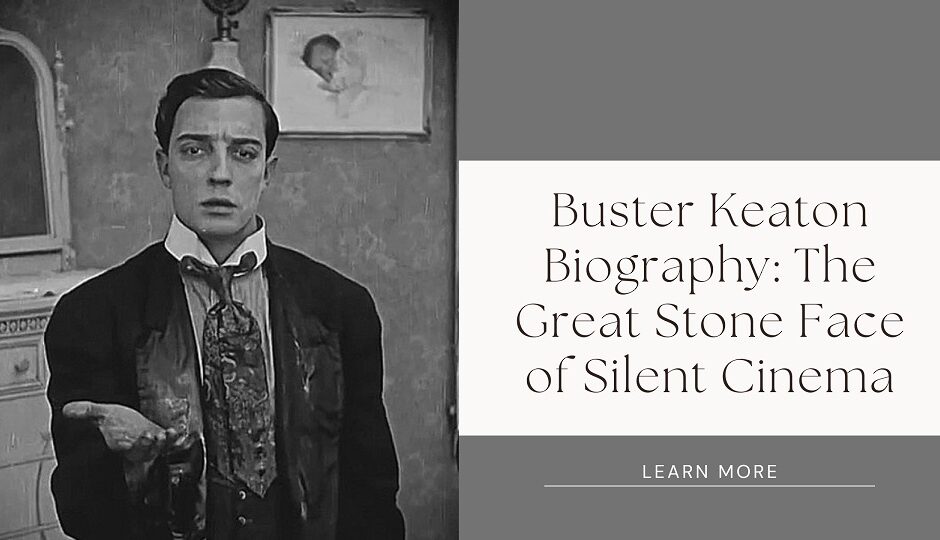
His most recognizable feature was, of course, his face—the “Great Stone Face” that never smiled, never registered fear, and never broke character regardless of the chaos surrounding him. This deadpan expression became his trademark and the visual signature of his comedy.
Net Worth and Income Sources
At the height of his independent career in the 1920s, Buster Keaton earned substantial sums—reportedly $3,000 per week during his MGM contract (equivalent to roughly $55,000 per week today). However, his divorce from Natalie Talmadge and the loss of his production company left him financially devastated. By the mid-1930s, he was effectively bankrupt.
At the time of his death in 1966, his estate was valued at approximately $500,000—modest by Hollywood standards but comfortable. Posthumously, his estate value has grown significantly through film licensing, home video releases, and streaming rights. The preservation and continued popularity of his silent films ensure that his work generates revenue decades after his passing.
His income sources throughout his career included:
- Independent film production (1920–1928): His most lucrative period, where he controlled profits from his Buster Keaton Comedies.
- MGM contract work (1928–1933): A steady salary that came at the cost of creative freedom.
- Short films (1934–1941): Modest payments from Educational and Columbia Pictures.
- Gag writing (late 1930s–1940s): Uncredited work for MGM, the Marx Brothers, and Red Skelton.
- Television and cameo appearances (1950s–1960s): Provided steady income during his career resurgence.
- Book royalties (1960 onward): From his autobiography and subsequent biographical works.
Interesting Facts About Buster Keaton
- He broke his neck filming Sherlock Jr. During the famous water-tank scene, a torrent of water fell on him with such force that it fractured his neck—but he didn’t realize it until years later when a doctor discovered the healed injury.
- Salvador Dalí was a fan. The surrealist artist declared Keaton’s works to be prime examples of “anti-artistic” filmmaking, calling them “pure poetry,” and created a 1925 collage titled The Marriage of Buster Keaton.
- He never smiled on camera. Keaton’s on-screen persona never broke into a smile, believing that “the more serious I turned, the bigger laugh I could get.” Off-camera, however, he was known to be warm and engaging.
- He performed the house-falling stunt in one take. The iconic scene from Steamboat Bill, Jr. (1928) was done without rehearsal—Keaton simply marked his spot and trusted the measurements. Had he been inches off, the two-ton facade would have killed him.
- He was a technical innovator. Keaton pioneered in-camera special effects, including the dream sequence in Sherlock Jr. where he appears to step into a movie screen. Modern filmmakers still study these techniques.
- He received a five-minute standing ovation at Venice. Months before his death, the Venice Film Festival audience honored him with an ovation so long it became legendary.
- Chaplin and Keaton appeared together only once. In Limelight (1952), the two greatest silent comedians shared the screen for the first and only time, playing aging vaudevillians performing one final act.
- His hearing loss affected his career. The ear infection from his WWI service left him with permanently impaired hearing, which became more challenging as the sound era arrived.
- He was a train enthusiast.The General reflected his lifelong love of trains, and he insisted on using real locomotives rather than models for maximum authenticity.
- The “Damfinos” society. The International Buster Keaton Society takes its nickname from a boat in his 1921 comedy The Boat.
Frequently Asked Questions (FAQ)
Q: How old was Buster Keaton when he died? A: Buster Keaton was 70 years old when he died on February 1, 1966, from lung cancer in Woodland Hills, California.
Q: What was Buster Keaton’s net worth? A: At the time of his death, Keaton’s estate was valued at approximately $500,000 (equivalent to roughly $5 million today). Posthumously, the value of his film legacy has grown substantially through licensing and distribution deals.
Q: What are Buster Keaton’s most famous films? A: His most celebrated works include The General (1926), Sherlock Jr. (1924), Steamboat Bill, Jr. (1928), The Navigator (1924), The Cameraman (1928), and Our Hospitality (1923). Seven of his films are preserved in the National Film Registry.
Q: Was Buster Keaton married? Did he have children? A: Yes, Keaton was married three times: to Natalie Talmadge (1921–1932, two sons), Mae Elizabeth Scrivens (1933–1935), and Eleanor Norris (1940 until his death). His first wife temporarily changed their sons’ last name to Talmadge and restricted his access to them during their childhood.
Q: Why was he called “Buster”? A: The nickname was reportedly given by magician Harry Houdini after infant Keaton took a dramatic fall down a staircase. In vaudeville slang, a “buster” meant a stage fall.
Q: Did Buster Keaton win an Oscar? A: He never won a competitive Academy Award, but received an Honorary Academy Award in 1960 for his unique talents in bringing immortal comedies to the screen.
Q: What made Buster Keaton’s comedy unique? A: Keaton’s comedy was defined by his deadpan “Great Stone Face” expression, death-defying practical stunts, elaborate mechanical gags, and innovative use of the camera. Unlike Chaplin, he never sought audience sympathy—his characters simply endured chaos with stoic determination.
Q: How did Buster Keaton influence modern cinema? A: Keaton pioneered visual storytelling techniques, in-camera special effects, and practical stunt work that influenced filmmakers from Jacques Tati and Richard Lester to modern directors like Christopher Nolan and performers like Jackie Chan. His films are studied in film schools worldwide as masterclasses in visual comedy.
Conclusion: The Enduring Legacy of Buster Keaton
Buster Keaton’s impact on cinema transcends the silent era. While contemporaries like Charlie Chaplin moved audiences through pathos and Harold Lloyd inspired through optimism, Keaton carved out a unique space as cinema’s great stoic—a man who faced absurdity, danger, and chaos with nothing more than an unblinking gaze and perfect physical timing.
His influence echoes through every filmmaker who has ever staged an elaborate practical stunt, every comedian who has maintained deadpan in the face of disaster, and every director who has trusted visual storytelling over dialogue. From Jackie Chan to Wes Anderson, from Inception to Jackass, Keaton’s DNA runs through modern entertainment.
Though his career suffered a devastating decline in the 1930s, his resurgence in the 1950s and the posthumous rediscovery of his silent masterpieces have cemented his status as arguably the greatest of all silent comedians. Seven of his films rest in the National Film Registry. His work continues to delight 21st-century audiences with the same freshness it possessed a century ago.
Buster Keaton did not merely make comedies—he expanded the language of cinema itself, proving that silence could speak louder than words and that a straight face could generate more laughter than a thousand pratfalls. His legacy is not just preserved in film archives; it lives every time a filmmaker dares to do something dangerous, something impossible, something purely visual—and makes it look effortless.