

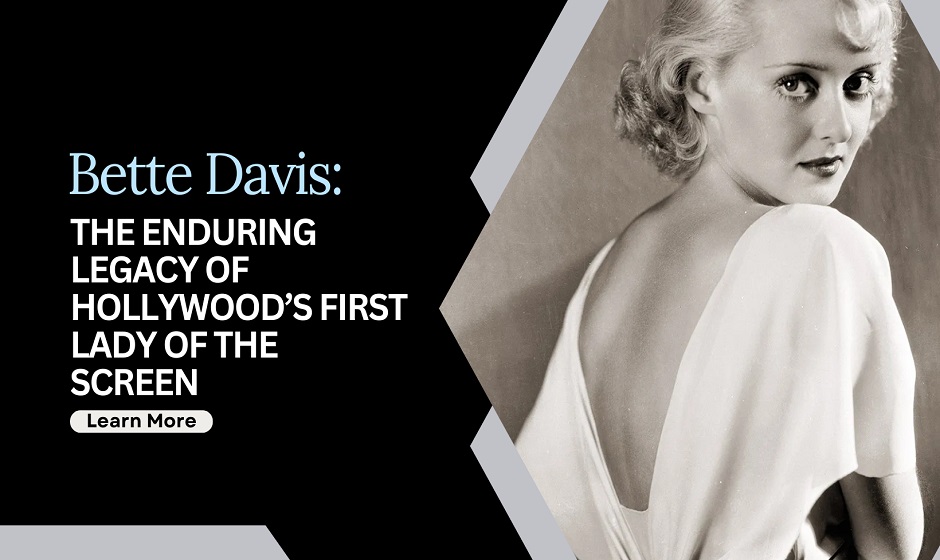

When the American Film Institute ranked the greatest female stars of classic Hollywood cinema, only one name surpassed Bette Davis. Yet, for millions of fans and film historians, Davis remains unrivaled—a ferocious talent who refused to play by the rules. Known for her clipped, transatlantic accent, those famous “Bette Davis eyes,” and a willingness to portray unsympathetic, complex women, she wasn’t just a movie star; she was a force of nature. In a career spanning six decades and over 100 films, Davis redefined what a leading lady could be, proving that intelligence and grit were far more captivating than damsel-in-distress stereotypes.
This is the story of Ruth Elizabeth Davis: the woman who fought the studio system, won two Oscars, and became the “First Lady of the Screen.”
Quick Facts: Bette Davis
Early Life and Family Background
Bette Davis was born Ruth Elizabeth Davis on April 5, 1908, in Lowell, Massachusetts. She was the daughter of Harlow Morrell Davis, a patent attorney, and Ruth Augusta (Favor) Davis. Her parents were distinctly different; her father was stern and authoritarian, while her mother was a spirited, independent woman who had aspirations of becoming an actress.
When Bette was just seven years old, her parents separated, a traumatic event that left the family in genteel poverty. Her father essentially abandoned the family financially, forcing Bette, her younger sister Barbara, and their mother to move frequently, living in boarding houses and relying on the kindness of relatives. This early hardship forged Bette’s steely determination and fierce protective instinct for her mother, whom she adored. Ruth Favor Davis eventually took up professional photography to support her daughters, instilling in Bette a work ethic that would define her career.
Education and Theatrical Beginnings
Bette attended Cushing Academy, a boarding school in Ashburnham, Massachusetts. It was here that she discovered her passion for performance. Initially aspiring to be a dancer, she switched to acting after realizing the dramatic power of spoken dialogue.
After graduating, she moved to New York City to pursue the stage. Her first attempt to join Eva Le Gallienne’s prestigious civic repertory company ended in failure—the famous actress told the young Davis she lacked the seriousness and talent for the theater. Undeterred, Davis channeled her frustration into action. She enrolled in John Murray Anderson’s dramatic school, where her raw, obsessive dedication quickly made her a star pupil. She made her Broadway debut in 1929 in the play Broken Dishes, and followed it with Solid South. While the reviews were modest, her powerful presence caught the eye of Universal Pictures, who offered her a movie contract.
The Complete Career Journey: A Fight for Respect
The Early Struggles (1930–1934)
Davis arrived in Hollywood in 1930 with high hopes, but Universal Studios didn’t know what to do with her. Studio executives famously declared she had “no sex appeal” and was “as sexless as a pair of old tennis shoes.” She was relegated to forgettable roles in films like Bad Sister (1931) and Seed (1931). After a series of flops, Universal dropped her option.
Refusing to give up, she landed at Warner Bros. in 1932. While Warner Bros. gave her steady work (such as The Man Who Played God), they saw her as a utility player, not a star. She was loaned out to RKO for the film that would change her life: Of Human Bondage (1934).
The Breakthrough: Of Human Bondage (1934)
Playing the vulgar, vicious Cockney waitress Mildred Rogers, Davis delivered a performance so raw and realistic that it shocked audiences. Although she was not officially nominated for an Academy Award (a snub considered one of the biggest in Oscar history), the outcry was so loud that the Academy allowed a write-in vote. While she didn’t win, the controversy shot her to fame and established her as a serious dramatic actress.
Superstardom and Two Oscars (1935–1949)
Warner Bros. finally recognized her value. She won her first Academy Award for Best Actress for Dangerous (1935)—a role many felt was a “consolation prize” for the Of Human Bondage snub. But it was Jezebel (1938) that solidified her legend. Playing the headstrong Southern belle Julie Marsden, she won her second Oscar. It was the first of five consecutive years she would be nominated for Best Actress.
The late 1930s and 1940s saw Davis at the height of her powers. She famously fought to play Queen Elizabeth I in The Private Lives of Elizabeth and Essex (1939), insisting she was not too young for the role (she wore a prosthetic nose and aged herself). The hits kept coming: Dark Victory (1939), The Letter (1940), The Little Foxes (1941), and the romantic masterpiece Now, Voyager (1942). During WWII, she was a tireless war worker, co-founding the Hollywood Canteen, a club for servicemen to get free food and entertainment.
The Comeback Queen (1950–1962)
By the late 1940s, Davis’s career had stagnated. She was tired of Warner Bros. and left the studio. At 42, she was considered “over the hill” in an industry obsessed with youth. Then came All About Eve (1950). Her portrayal of Margo Channing, an aging Broadway star facing obsolescence, was a triumph of wit and vulnerability. It is widely considered her greatest performance and earned her another Oscar nomination. The film revitalized her career and is now a landmark of American cinema.
However, the 1950s were rocky again until she reinvented herself in the horror genre with What Ever Happened to Baby Jane? (1962). Playing the psychotic former child star Jane Hudson opposite her real-life rival Joan Crawford, Davis created an unforgettable villain. The film was a massive box office hit, earning Davis her final Academy Award nomination. The behind-the-scenes feud between Davis and Crawford became the stuff of Hollywood legend.
Later Career (1963–1989)
In her later years, Davis transitioned smoothly into character roles and television. She won a Golden Globe and an Emmy Award for Strangers: The Story of a Mother and Daughter (1979). She also appeared in films like Death on the Nile (1978) and The Whales of August (1987), holding her own alongside Lillian Gish. Even after suffering a mastectomy and several strokes, she continued acting until shortly before her death in 1989.
Personal Life, Lifestyle, and Family
Bette Davis once wrote, “My success has always been at the expense of my personal relationships.” She was married four times:
- Harmon Nelson (1932–1938): A musician, their marriage fell apart due to her rising fame.
- Arthur Farnsworth (1940–1943): A restaurateur. Tragically, he died suddenly of a skull fracture after a fall.
- William Grant Sherry (1945–1950): A sculptor. They had her only biological child, Barbara Davis Sherry (B.D. Hyman).
- Gary Merrill (1950–1960): An actor she met on All About Eve. They had a volatile, alcohol-fueled relationship and adopted two children, Margot and Michael.
Davis was a complex, often difficult woman. She was a perfectionist who demanded the best from herself and everyone else. She raised her children largely as a single parent. However, her later years were marred by a bitter estrangement from her daughter B.D., who wrote a sensational tell-all book, My Mother’s Keeper, portraying Davis as a cruel mother. Davis was heartbroken and cut her daughter out of her will.
Physical Appearance and Fitness
Bette Davis stood at just 5 feet 2 inches (1.61 meters). She was petite, a fact often hidden by the grand costumes and powerful camera angles used in her films. She weighed approximately 127 pounds (58 kg). She had striking, large blue eyes—often described as “protruding”—which became her most famous feature. Though she was not a conventional beauty (she frequently acknowledged this), she used her expressive eyes and her unique, clipped vocal delivery to hypnotize the camera.
Net Worth and Income Sources
At the time of her death in 1989, Bette Davis had an estimated net worth of $2 million. Her wealth came primarily from her film salaries (at her peak, she was one of the highest-paid women in America), real estate holdings, and residual payments for television reruns.
Davis managed her finances carefully. She owned a historic estate in Hollywood Hills and a home in Connecticut. She also collected valuable antiques and artwork. However, her final years were expensive due to her medical battles. Interestingly, she left nothing to her daughter, B.D. Hyman, due to their estrangement, instead leaving her estate to her assistant and her adopted son.
5 Interesting Facts About Bette Davis
- She Named the “Oscar”: Legend has it that Davis was the first person to call the golden statuette “Oscar,” claiming it looked like her first husband Harmon Nelson’s backside (his middle name was Oscar).
- She was the First Female President of AMPAS: In 1941, she was elected president of the Academy of Motion Picture Arts and Sciences, though she resigned after a few weeks due to the workload.
- “Bette Davis Eyes”: The 1981 Kim Carnes song was a massive hit. Davis, then in her 70s, loved the song and wrote to the singers to thank them, saying it made her cool in the eyes of her grandchildren.
- She Battled the Studio System: She famously sued Warner Bros. in the 1930s to get out of her contract over poor roles. She lost the case, but it forced the studios to improve their contracts for actors.
- She Suffered from a Phobia: Davis had a severe fear of being buried alive (taphophobia). Due to this, she insisted on being cremated immediately after her death.
Frequently Asked Questions (FAQ)
Q1: How old was Bette Davis when she died?
A: Bette Davis was 81 years old. She was born on April 5, 1908, and died on October 6, 1989.
Q2: What was Bette Davis’ net worth?
A: Her estate was estimated to be worth approximately $2 million at the time of her death.
Q3: What are Bette Davis’ most famous movies?
A: Her most acclaimed films include All About Eve (1950), What Ever Happened to Baby Jane? (1962), Jezebel (1938), Now, Voyager (1942), Of Human Bondage (1934), and Dark Victory (1939).
Q4: Did Bette Davis have children?
A: Yes. She had one biological daughter, B.D. Hyman (with William Sherry), and adopted two children with Gary Merrill: a daughter named Margot and a son named Michael.
Q5: Why did Bette Davis and Joan Crawford hate each other?
A: Their rivalry was legendary. It stemmed from professional jealousy, competition for roles (and men), and clashes of personality. Davis was an intense, serious actress; Crawford was a disciplined, glamorous star. Their hatred peaked during the filming of What Ever Happened to Baby Jane? where they reportedly sabotaged each other on set.
Conclusion: The Future of Her Legacy
Bette Davis passed away on October 6, 1989, in Neuilly-sur-Seine, France, after a long battle with breast cancer. While the “future prospects” of a living person do not apply, the future of her legacy is secure. In an era of streaming and digital preservation, a new generation is discovering her work. Her films—All About Eve, Jezebel, Now, Voyager—remain timeless because they speak to the human condition with brutal honesty.
Davis was a pioneer. She was the first actress to achieve 10 Academy Award nominations. She was a woman who refused to be “just a pretty face.” She was, as she famously said, a “survivor.” For anyone who loves great acting—bold, brave, and unafraid of looking ugly or desperate—Bette Davis remains the gold standard.